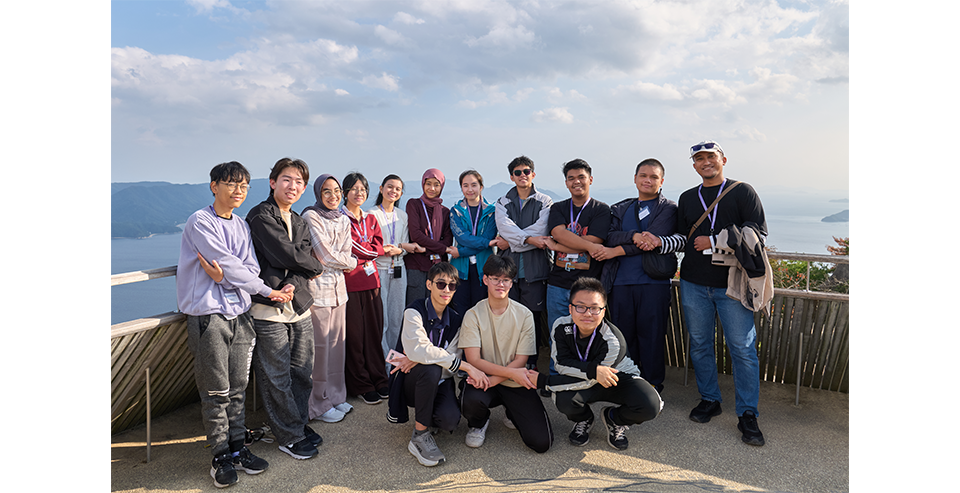
The ASEAN-Japan Peace Ambassador Project (AJPAP), a Japan-ASEAN youth exchange initiative to promote peace and dialogue, was launched in 2025, a milestone year marking 80 years since the end of World War II. The first Japan visit program was conducted primarily in Hiroshima, a city recognized as a symbol of peace.
The program will continue on an annual basis, bringing together a total of 10 to 15 high school students from Japan and 3 to 4 ASEAN countries to explore peace through dialogue and collaboration.
For the inaugural AJPAP 2025, 12 high school students from Indonesia, the Philippines, Vietnam, and Japan gathered in Hiroshima. Participants took part in expert-led lectures and workshops, engaged in fieldwork at the Hiroshima Peace Memorial Museum, the Peace Memorial Park, and Mt. Misen in Miyajima, and collaborated on a group art project. These learning experiences combined with dialogue enabled the students to examine peace from multiple perspectives.
Day 1: Friday, October 31
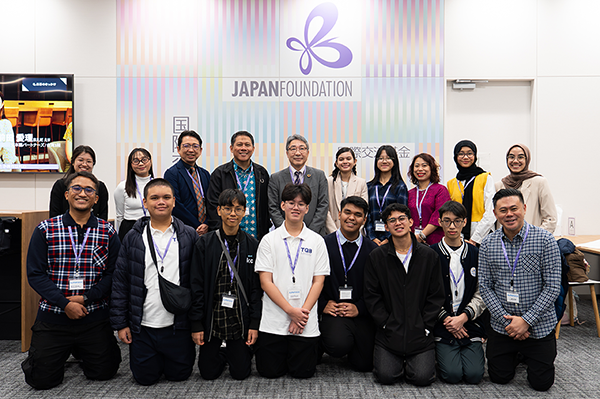
At an orientation for participants arriving from the ASEAN countries, the students listened to messages from Mr. Kurosawa Shinya, President of The Japan Foundation and Ms. Gonda Ai, Director of the Cultural Affairs and Overseas Public Relations Division, Ministry of Foreign Affairs of Japan. Together, they confirmed and shared their understanding of the objectives of the Japan visit program and the way in which they would approach it.
In the afternoon, the ASEAN participants traveled to Hiroshima, where they were joined by the Japanese students who welcomed them at Hiroshima Station.
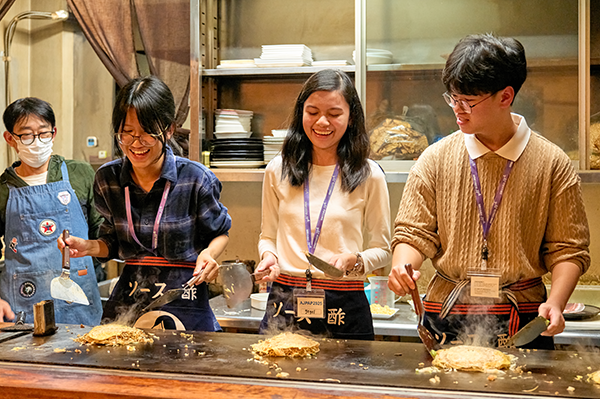
That evening, all participants reviewed the overall program schedule together and formed friendships while enjoying Hiroshima’s signature dish, okonomiyaki.
Day 2: Saturday, November 1
The participants began the day with a visit to the Hiroshima Peace Memorial Museum, followed by a testimony and lecture by Ms. Tanaka Toshiko, who experienced the atomic bombing as an elementary school student. Through dialogue with Ms. Tanaka, who has fostered friendships throughout the world beyond her memories of the atomic bombing and regardless of who had suffered or inflicted harm, participants received a simple yet important message: “Please make friends all over the world.”
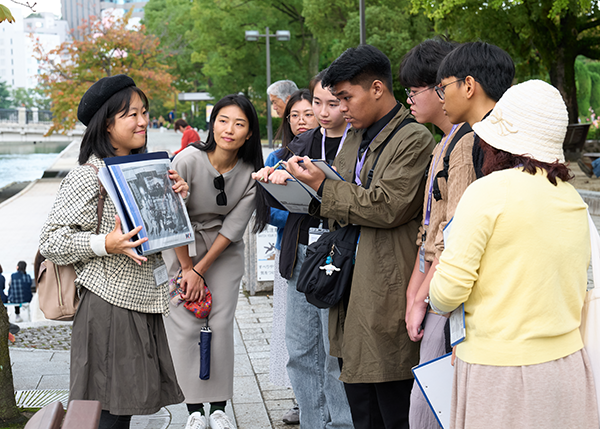
Afterward, the group went on a guided tour of the Peace Memorial Park, led by “Peace Buddies,” who are local youth guides of a similar age. Through this “PEACE DIALOGUE” program, which encourages discussions and the sharing of ideas and opinions, the young people of Japan and ASEAN reflected on the everyday life that once existed at the hypocenter and deepened their understanding of peace while learning about the realities of the atomic bombing and the memories of war.
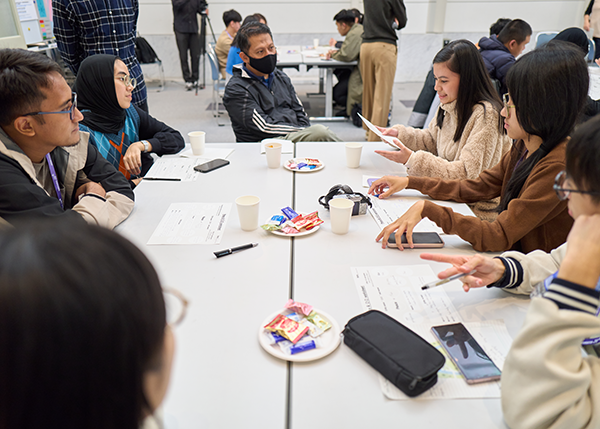
In the afternoon, participants joined a workshop facilitated by Mr. Sumioka Kenta of PCV, exploring how their own interests and strengths could be connected to peacebuilding. The session provided students with an opportunity to view peace as something personally relevant to their own lives.
Day 3: Sunday, November 2
The participants traveled to Miyajima, where they focused on self-reflection and “inner peace.”
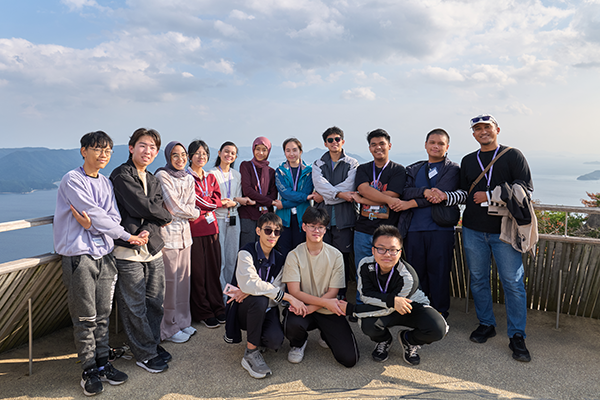
Together, the group hiked to Kiezu no Reikado Hall on the summit of Mt. Misen, where they viewed the “Eternal Flame,” which has been burning continuously for more than 1,200 years. The flame is also known as the source of the “Flame of Peace” that burns in the Peace Memorial Park, which the students had visited the previous day. The participants transferred the flame to a lantern and carried it back to Daisho-in Temple.
At Daisho-in Temple, the participants took part in a workshop led by Ms. Momoe, founder of Zen Eating, followed by a meditation session guided by Mr. Yoshida Daiyu, Deputy Head Priest of Daisho-in Temple. These activities provided an opportunity for the participants to reflect quietly on their individual inner peace.
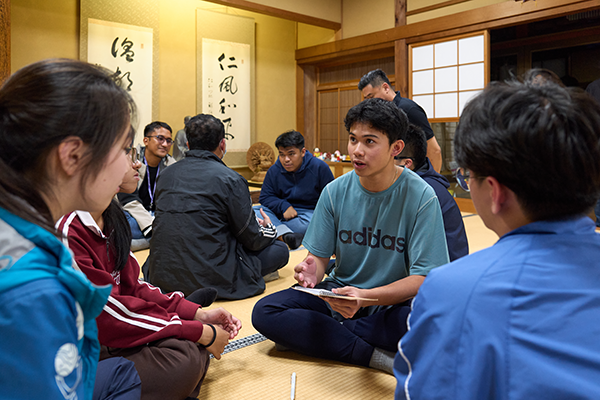
In the evening, the students gathered around a campfire within the temple grounds. Sitting in front of the “Eternal Flame” that they had brought back, they spoke to one another about their learning experiences and the emotions that they were feeling.
Day 4: Monday, November 3
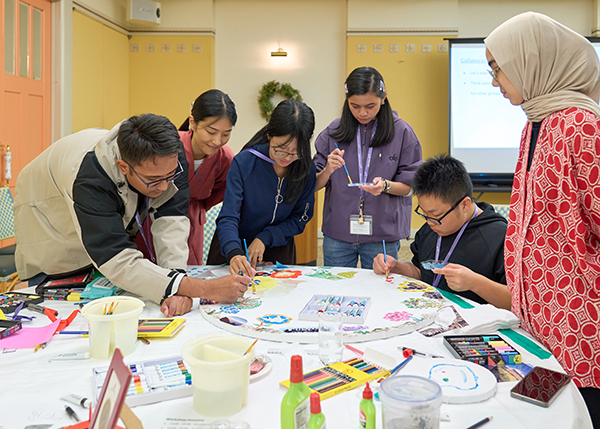
On the final day, the participants returned to Hiroshima City. Following a lecture by Mr. Kamal Mamat of the ASEAN Secretariat’s Education, Youth and Sports Division, all participants worked together to create a collaborative artwork under the guidance of Mr. Arita Taiki, a contemporary artist based in Hiroshima.
Using photographs that each student had brought from their home country representing “what makes me think of peace,” together with the origami cranes dedicated to the “Children’s Peace Monument” in the Peace Memorial Park (provided by the City of Hiroshima), the students discussed motifs, design ideas, and who would be responsible for which part of the activity before creating one large artwork and a smaller individual artwork to take home.
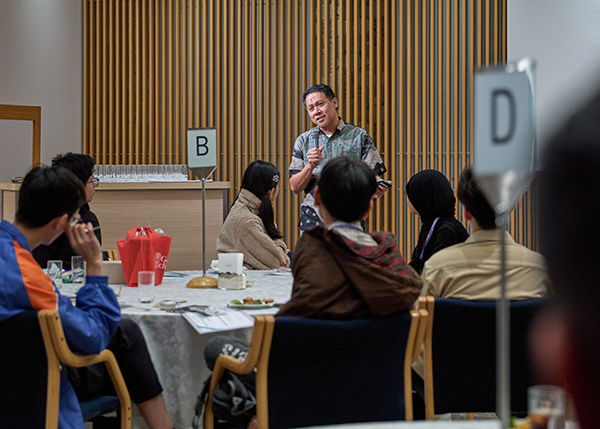
During the farewell reception that evening, Dr. Sato Yuri, Advisor and Member of the Executive Board of The Japan Foundation at the time, presented certificates of completion to mark the conclusion of the program. Each participant then expressed their commitment to serving as a Peace Ambassador.
Monday, January 12, 2026
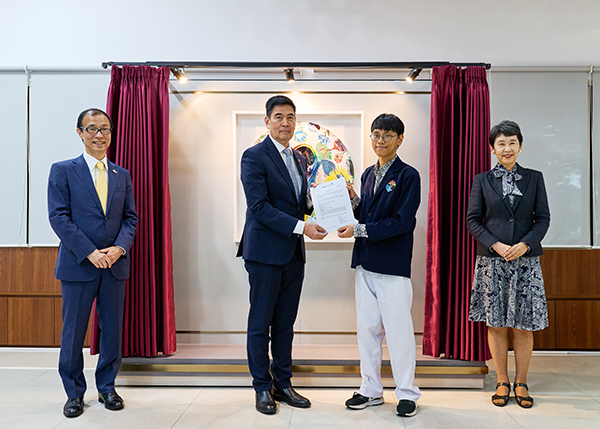
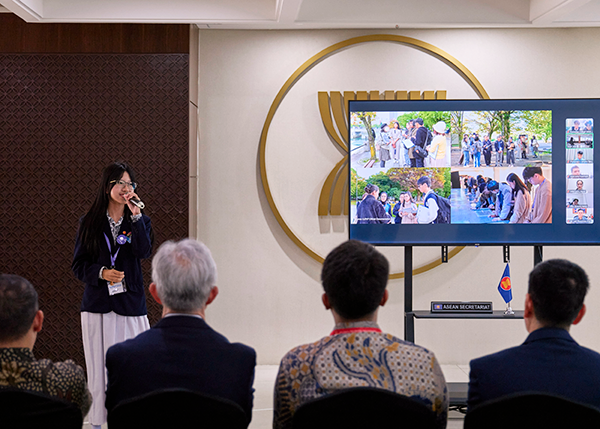
At the ASEAN Headquarters in Jakarta, an Outcomes Report and Artwork Presentation Ceremony was held in the presence of H.E. San Lwin, Deputy Secretary-General of ASEAN and H.E. Yonetani Koji, Ambassador of Japan to ASEAN. Three student participants and one accompanying teacher from Indonesia, together with Dr. Sato Yuri, Executive Vice President of The Japan Foundation and other representatives, attended in person while high school students and teachers from other countries joined online.
Participants from each country reported on the learning experiences and insights they had gained as Peace Ambassadors. The event provided an opportunity for everyone involved to share the initiatives undertaken and the outcomes achieved through AJPAP 2025 and recognize the importance of continued exchange and cooperation in the future.
Following the report, a student representative presented the large collaborative artwork, entitled “A Piece of Peace,” to H.E. San Lwin, Deputy Secretary-General of ASEAN. The artwork was subsequently added to the ASEAN Gallery collection and displayed there for a month.
Outline
| Dates | (Japan Visit Program) Friday, October 31 – Monday, November 3, 2025 (Outcomes Report) Monday, January 12, 2026 |
|---|---|
| Host Countries | Japan, Indonesia |
| Venues | (Japan Visit Program) Hiroshima, Tokyo; (Outcomes Report) Jakarta |
| Participating Countries | Japan, Indonesia, the Philippines, Vietnam |
| Participants | High School Students Japan: Awano Eito / AICJ Senior High School Hananoki Haru / Sotoku High School Jyou Miki / AICJ Senior High School Indonesia: Calma Salsabyla / SMA Negeri 8 Jakarta Gabriella Karin Resyana / SMA Negeri 8 Jakarta Kyandasha Gabriel Daniel Abadi Pitoy / SMA Negeri 8 Jakarta The Philippines: Dacumos Idhreniel Agojo / Marist School Marikina Ramos Zachary John Rabanal / Palawan National School Tan Johann Seth Bacerra / Ateneo de Zamboanga University Senior High School Vietnam: Duong Nhat Minh / Ta Quang Buu Secondary and High School Nguyen Khoi Anh / Ta Quang Buu Secondary and High School Nguyen Minh Khanh / Ta Quang Buu Secondary and High School Accompanying Teachers Indonesia: Fakhrizal Arsi / SMA Negeri 8 Jakarta The Philippines: Pioquinto Jeffrey Urian / Ateneo de Zamboanga University Senior High School Vietnam: Nghiem Thi Thuy Nga / Ta Quang Buu Secondary and High School Observer Kamal Mamat / ASEAN Secretariat *Note: In alphabetical order, titles omitted. |
| Organizer | The Japan Foundation (JF) |
| Co-organizer | NPO Peace Culture Village (PCV) (a recipient of the Japan Foundation Prizes for Global Citizenship in FY 2022) |
| Cooperating Organization | ASEAN Secretariat *Note:The event on January 12 was co-organized by the ASEAN Secretariat. |